
Writeup for
"Positively Going
Bananas!"
CRYPTO (EASY) — JERSEYCTF VI (2026)
CHALLENGE CONTEXT
"The chimps are out of control at the astronaut training facility, and the flashing error screens on the monitor is making them more rabid! What do we do??"
(…and a file containing PNGs of each monitor in numerical order.)
Download .ZIP file here
THOUGHT PROCESS
When analyzing the monitors, there are only two things that change about each individual one:
The error codes, some of which repeat
The color of each monitor
That means those aspects are probably the most important when it comes to retrieving the flag. The monitors are also probably in numerical order for a reason.
ERROR CODES
Knowing the final flag has to be a string, there are various ways of decoding numbers to letters, such as Binary, A1Z26 (Standard), A0Z25 (Zero-based), Hexadecimal, and ASCII.
We can knock a few of these out.
It can't be A1Z26 / A0Z25, because the numbers are beyond the given range in these methods (42 > 25/26)
It can't be Binary, because the numbers are too short.
That leaves Hex and ASCII. Using some online resources we can see that 42 decodes into a number in Hex (B) and a character in ASCII (*).
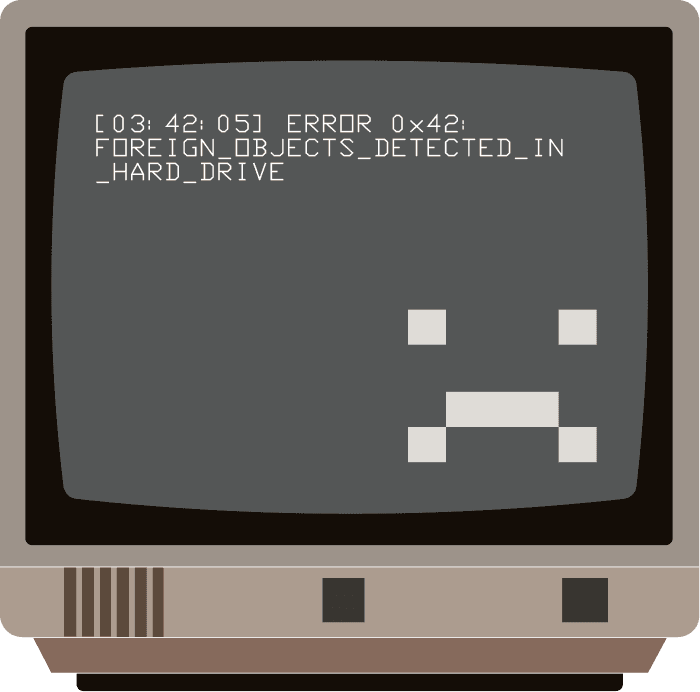
DECODING THE ERROR CODES
Using the table from above and other resources, we can start to manually (and slowly) decode the error codes (or find an online decoder) using Hex. We end up with…
BANANAS
Not Done Yet!
Given the nature of the challenge context, the flag is probably the answer to the question. BANANAS could be an answer…but if you tried inputting it, it wouldn't work. So there's something missing.
The challenge context specifically mentions the flashing screens, and not just the error codes themselves, so we should take a look back. The colors of each screen also vary with each error code, so how can we analyze that?
Hmm…
COLORS!
(Nearly) every color on the Internet can also be written as a Hex code! For example, this grey color can be written as #424544.
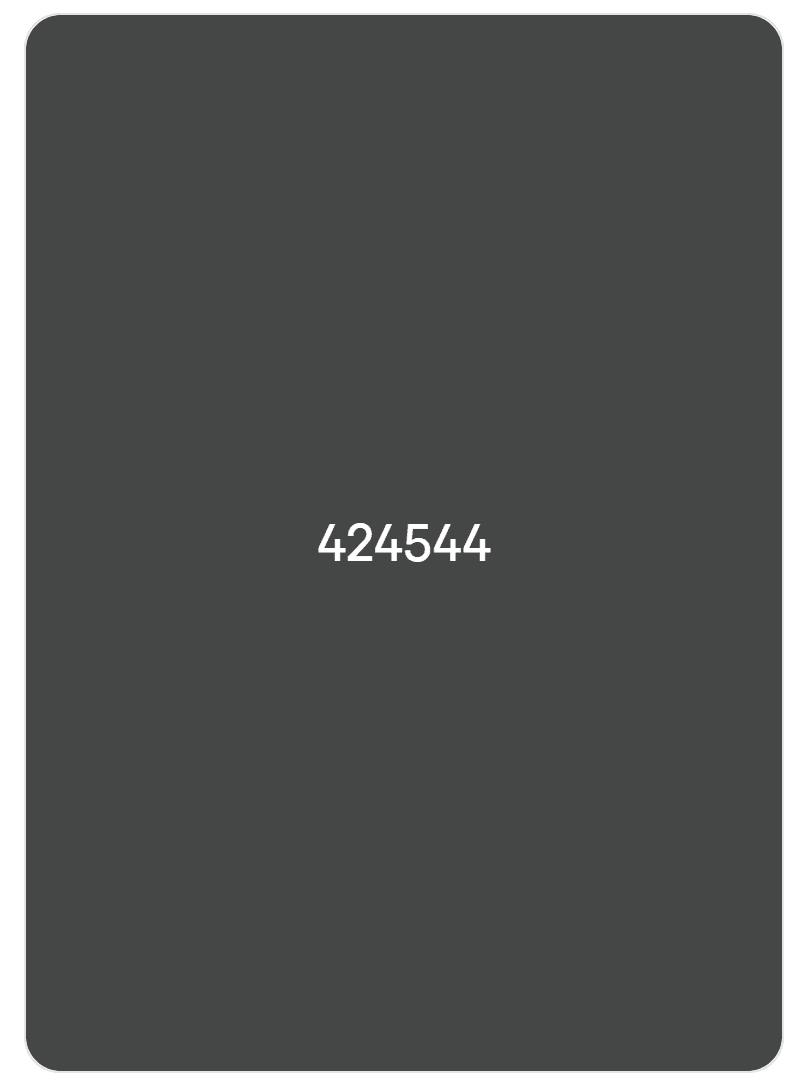
When we were decrypting the error codes, we could already see that numbers could be encrypted using HEX. We can apply that same pattern and logic with these colors — each color code can be split into three numerical pairs, each corresponding to a letter.
For example…
Grey → #424544 → 42, 45, 44 → B, E, D → BED
DECODING THE MONITOR COLORS
By eyedropping each monitor, we get their respective HEX codes:
Monitor 1: #545656 → 54, 56, 56 → TVV
Monitor 2: #584C4C → 58, 4C, 4C → XLL
Monitor 3: #4C5856 → 4C, 58, 56 → LXV
Monitor 4: #4B584D → 4B, 58, 4D → KXM
Monitor 5: #555447 → 55, 54, 47 → UTG
Monitor 6: #544754 → 54, 47, 54 → TGT
Monitor 7: #554851 → 55, 48, 51 → UHQ
Monitor 8: #2C61CB → 2C, 61, CB → the last character is out of range, so this monitor isn't part of the string.
This leaves a final string of…
TVVXLLLXVKXMUTGTGTUHQ
WHAT'S NEXT?
The letters are frequent and uniform, implying a simple cipher. 'Going positively' implies a shift, and you're 'shifting' BANANAS — that is, the length of the key BANANAS (7 letters).
By shifting the entire string +7, you end up with…
ACCESSSECRETBANANABOX
which you would wrap in jctf{} and submit!
⚐ jctf{ACCESSSECRETBANANABOX}
THANK YOU!
Thanks for taking the time to complete this challenge! This was one of two challenges I developed for my first CTF, and I have absolutely no experience with coding so I had to find workarounds (Figma FTW).
If you're interested in reading the writeup for "Play Fair, Punch!", you can check it out below.

'Play Fair, Punch!' Writeup
Writeup for "Positively Going Bananas!"
MISC (EASY) — JERSEYCTF VI (2026)
challenge context
"The chimps are out of control at the astronaut training facility, and the flashing error screens on the monitor is making them more rabid! What do we do??"
(…and a file containing PNGs of each monitor in numerical order.)
Download .ZIP file here
THOUGHT PROCESS
When analyzing the monitors, there are only two things that change about each individual one:
The error codes, some of which repeat
The color of each monitor
That means those aspects are probably the most important when it comes to retrieving the flag. The monitors are also probably in numerical order for a reason.
ERROR CODES
Knowing the final flag has to be a string, there are various ways of decoding numbers to letters, such as Binary, A1Z26 (Standard), A0Z25 (Zero-based), Hexadecimal, and ASCII.
We can knock a few of these out.
It can't be A1Z26 / A0Z25, because the numbers are beyond the given range in these methods (42 > 25/26)
It can't be Binary, because the numbers are too short.
That leaves Hex and ASCII. Using some online resources we can see that 42 decodes into a number in Hex (B) and a character in ASCII (*).
DECODING the ERROR CODEs
Using the table from above and other resources, we can start to manually (and slowly) decode the error codes (or find an online decoder) using Hex. We end up with…
Not Done Yet!
Given the nature of the challenge context, the flag is probably the answer to the question. BANANAS could be an answer…but if you tried inputting it, it wouldn't work. So there's something missing.
The challenge context specifically mentions the flashing screens, and not just the error codes themselves, so we should take a look back. The colors of each screen also vary with each error code, so how can we analyze that?
Hmm…
COLORS!
(Nearly) every color on the Internet can also be written as a Hex code! For example, this grey color can be written as #424544.
When we were decrypting the error codes, we could already see that numbers could be encrypted using HEX. We can apply that same pattern and logic with these colors — each color code can be split into three numerical pairs, each corresponding to a letter.
For example…
Grey → #424544 → 42, 45, 44 → B, E, D → BED
decoding the monitor colors
By eyedropping each monitor, we get their respective HEX codes:
Monitor 1: #545656 → 54, 56, 56 → TVV
Monitor 2: #584C4C → 58, 4C, 4C → XLL
Monitor 3: #4C5856 → 4C, 58, 56 → LXV
Monitor 4: #4B584D → 4B, 58, 4D → KXM
Monitor 5: #555447 → 55, 54, 47 → UTG
Monitor 6: #544754 → 54, 47, 54 → TGT
Monitor 7: #554851 → 55, 48, 51 → UHQ
Monitor 8: #2C61CB → 2C, 61, CB → the last character is out of range, so this monitor isn't part of the string.
This leaves a final string of…
TVVXLLLXVKXMUTGTGTUHQ
WHAT'S NEXT?
We have a long string and the term 'BANANAS' from the error code that has to be important somehow.
Let's look back at the challenge context. Is there anything we're missing? The title says 'Positively Going Bananas', which directly mentions the term we just decoded. How can we do that…positively?
DECODING THE STRING
The letters are frequent and uniform, implying a simple cipher. 'Going positively' implies a shift, and you're 'shifting' BANANAS — that is, the length of the key BANANAS (7 letters).
By shifting the entire string +7, you end up with…
ACCESSSECRETBANANABOX
which you would wrap in jctf{} and submit!
⚐ jctf{ACCESSSECRETBANANABOX}
THANK YOU!
Thanks for taking the time to complete this challenge! This was one of two challenges I developed for my first CTF, and I have absolutely no experience with coding so I had to find workarounds (Figma FTW).
This was also (surprisingly) difficult for most LLMs to crack with no context, alongside maghwl' chon (a challenge in Klingon). Not intentional, but interesting to note moving forward.
If you're interested in reading the writeup for "Play Fair, Punch!", you can check it out below.
'Play Fair, Punch!' Writeup